logo
Products
PRODUCTS DETAILS
Home > Products >
Midea Ceiling Floor FCU with 180 Coil Rotation Adapts On Site 0 10V DC Demand Based Energy Control

Midea Ceiling Floor FCU with 180 Coil Rotation Adapts On Site 0 10V DC Demand Based Energy Control

Detail Information
Place of Origin
China
Brand Name
OEM;MIDEA
Certification
CB,ISO
Product Name:
Ceiling Floor FCU
Airflow Range:
400–800 CFM 400–800 CFM
Cooling Capacity:
1.58–8.25 KW 1.65–8.25 KW
Heating Capacity:
1.77–8.50 KW 1.85–8.50 KW
Power Input:
14–124 W 14–123 W
Sound Pressure Level (H):
34–53 DB(A) 23–51 DB(A)
Power Supply:
220–240V / 1Ph / 50Hz
Motor Type:
Low-noise 3-speed AC
Highlight:

Midea ceiling floor FCU

,

FCU with 180 coil rotation

,

0-10V DC FCU control

Product Description
Product Overview

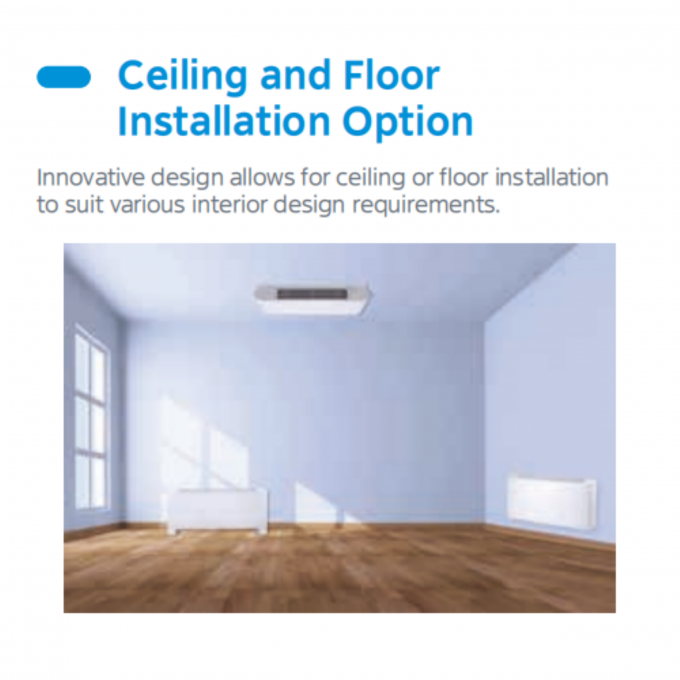
Tenancies change faster than equipment lifecycles: the ceiling zone becomes a floor zone, and the exposed unit needs to disappear above a new ceiling. The Midea 2nd Generation Ceiling & Floor Fan Coil Unit is the asset that keeps up — three mounting modes from a single platform: H1 (exposed floor standing with side return), H2 (exposed floor standing with bottom return), and H3 (concealed ceiling with 180° coil rotation). Units redeploy as layouts evolve instead of being written off and replaced. One family covers 400–800 CFM with cooling capacities from 1.58 to 8.25 kW across the AC and DC range, so the fleet stays useful through every churn cycle — and the spares shelf stays single-stream.

At 200–211 mm deep, the unit sits tight to walls and ceilings with no custom boxing to build, paint, or repair. Floor mode handles perimeter heating and cooling along glazing — where envelope loads concentrate and complaints follow — without competing for ceiling space already crowded with other services. H3 mode hides the unit completely above the ceiling and rotates the coil 180° for optimal supply and return positioning inside the void. The integrated controller recess mounts wired controllers flush, leaving no surface trunking for occupants to damage. Three-row and four-row coil options match two-pipe and four-pipe hydraulics across the building without site adaptation.

The DC inverter brushless version offers seven fan speeds via the KJR-75A controller plus 0–10V modulation, so output follows real demand under BMS-driven strategies — with up to 30% fan energy savings that accumulate quietly across the estate. XYE and PQE ports provide central control and Modbus RTU connectivity, bringing every unit's status and faults onto one central screen. Standard supply is 220–240V / 1Ph / 50Hz; Hongtai supports multi-site estates and export contracts with OEM/ODM custom voltage (180–440V, 50/60Hz), project branding, and protocol options.

Key Selling Points
  • Three Mounting Modes, One Platform — H1/H2/H3 redeploy as tenancies change; assets stay useful instead of being replaced.
  • 180° Coil Rotation (H3 Concealed) — Concealed ceiling duty without special-order variants or long lead times.
  • 200–211 mm Slim Depth — Sits tight to walls and ceilings; clean finish with no boxing to build or repair.
  • Floor Mode for Perimeter Zones — Handles glazing-line loads where complaints concentrate, without touching crowded ceilings.
  • Integrated Controller Recess — Flush-mounted controllers; no exposed trunking for occupants to damage.
  • Seven-Speed DC with 0–10V Modulation — Output follows real demand under BMS strategies; up to 30% fan energy saving.
  • XYE / PQE Ports — Central control and Modbus RTU bring every unit onto one monitoring screen.
  • 3-Row / 4-Row, 2-Pipe / 4-Pipe Options — Match building hydraulics without site adaptation.
  • OEM/ODM via Hongtai — Custom voltage, branding, and protocols for multi-site estates and export contracts.
AC vs DC — Which Should You Specify?

For simple comfort duty at the sharpest capital cost, AC 3-speed models do the job and keep spares universal. Where energy performance is audited, or demand-based control forms part of the BMS strategy, specify the DC inverter brushless version: seven speeds via the KJR-75A, 0–10V modulation for demand-driven output, and up to 30% fan energy savings. Mounting modes, dimensions, and coil options are identical across both — so one maintenance procedure and one spares list covers the entire fleet.

Applications
  1. Mixed-Use Developments — One platform serves concealed office floors and floor-standing ground-floor retail.
  2. Hotel Rooms with Crowded Ceilings — Floor mounting frees ceiling space already consumed by other services.
  3. Hospital Wards — Floor positioning allows easy cleaning around and beneath the unit in clinical environments.
  4. Perimeter Zones Along Glazing — Floor placement counters envelope heating and cooling loads where complaints concentrate.
  5. Churn-Heavy Office Space — Units redeploy between floor and ceiling duty as tenants change.
Frequently Asked Questions
Can units really be redeployed when a tenancy changes?

Yes — that is the point of the platform. H1, H2, and H3 mounting modes come from one unit, so a floor-standing asset today can be reconfigured for concealed ceiling duty as layouts evolve, instead of being written off and replaced.

Does floor mounting help cleaning regimes?

Yes. Floor-positioned units allow easy access around and beneath the casing — particularly valuable in wards and other hygiene-sensitive areas where cleaning must reach every surface.

Can output follow real demand instead of fixed speeds?

The DC version provides 0–10V modulation plus seven fan speeds, so output tracks real demand under BMS control strategies — cutting the wasted runtime that fixed-speed units accumulate in part-load conditions.

How do these units join the central BMS?

XYE and PQE ports provide central control and Modbus RTU connectivity, so every unit reports status and faults to one dashboard — no clipboard rounds required.

Can the whole estate run on one spare-parts list?

Yes. Both motor tiers share mounting hardware, dimensions, and coil options, and one platform covers both floor and ceiling duty — so spares holding and technician training stay single-stream.

Certifications & Standards
  • CE Marking — European conformity for safety and electromagnetic compatibility.
  • Eurovent Certified Performance — Third-party verified capacity and efficiency ratings.
  • ERP Compliant — Meets EU Energy-related Products Directive requirements.
  • RoHS Compliant — Restriction of Hazardous Substances directive conformance.
  • GB/T 19232 — Chinese national standard for fan coil unit performance testing.
Technical Specifications
Parameter AC Series DC Series
Airflow Range400–800 CFM400–800 CFM
Cooling Capacity1.58–8.25 kW1.65–8.25 kW
Heating Capacity1.77–8.50 kW1.85–8.50 kW
Power Input14–124 W14–123 W
Sound Pressure Level (H)34–53 dB(A)23–51 dB(A)
Power Supply220–240V / 1Ph / 50Hz220–240V / 1Ph / 50Hz
Body Thickness200–211 mm200–211 mm
Coil Rows3 / 43 / 4
Max. Working Pressure1.6 MPa1.6 MPa
Motor TypeAC fan motorDC Brushless
Pipe ConnectionG3/4"G3/4"
Mounting OptionsH1 / H2 / H3H1 / H2 / H3
Pipe System2-pipe / 4-pipe2-pipe / 4-pipe
External Static Pressure0 / 12 Pa (H3)0 / 12 Pa (H3)
Related Search Terms
  • ceiling floor fan coil unit flexible mounting
  • floor standing FCU for perimeter zone
  • concealed ceiling fan coil 180 rotation
  • fan coil unit redeployment tenant change
  • 0-10V demand control fan coil
  • dual mount FCU spare parts
  • under window fan coil unit
  • easy clean fan coil for hospital ward
Midea ceiling and floor fan coil unit shown in floor-standing configuration with slim 200–211 mm body depth
Midea FCU concealed ceiling mounting mode with 180-degree coil rotation for optimal supply and return positioning
Midea fan coil unit integrated controller recess with flush-mounted wired controller and no exposed trunking
Midea 2nd generation ceiling and floor fan coil unit platform showing H1, H2 and H3 mounting configurations
Products
PRODUCTS DETAILS
Midea Ceiling Floor FCU with 180 Coil Rotation Adapts On Site 0 10V DC Demand Based Energy Control
Detail Information
Place of Origin
China
Brand Name
OEM;MIDEA
Certification
CB,ISO
Product Name:
Ceiling Floor FCU
Airflow Range:
400–800 CFM 400–800 CFM
Cooling Capacity:
1.58–8.25 KW 1.65–8.25 KW
Heating Capacity:
1.77–8.50 KW 1.85–8.50 KW
Power Input:
14–124 W 14–123 W
Sound Pressure Level (H):
34–53 DB(A) 23–51 DB(A)
Power Supply:
220–240V / 1Ph / 50Hz
Motor Type:
Low-noise 3-speed AC
Highlight

Midea ceiling floor FCU

,

FCU with 180 coil rotation

,

0-10V DC FCU control

Product Description
Product Overview

Tenancies change faster than equipment lifecycles: the ceiling zone becomes a floor zone, and the exposed unit needs to disappear above a new ceiling. The Midea 2nd Generation Ceiling & Floor Fan Coil Unit is the asset that keeps up — three mounting modes from a single platform: H1 (exposed floor standing with side return), H2 (exposed floor standing with bottom return), and H3 (concealed ceiling with 180° coil rotation). Units redeploy as layouts evolve instead of being written off and replaced. One family covers 400–800 CFM with cooling capacities from 1.58 to 8.25 kW across the AC and DC range, so the fleet stays useful through every churn cycle — and the spares shelf stays single-stream.

At 200–211 mm deep, the unit sits tight to walls and ceilings with no custom boxing to build, paint, or repair. Floor mode handles perimeter heating and cooling along glazing — where envelope loads concentrate and complaints follow — without competing for ceiling space already crowded with other services. H3 mode hides the unit completely above the ceiling and rotates the coil 180° for optimal supply and return positioning inside the void. The integrated controller recess mounts wired controllers flush, leaving no surface trunking for occupants to damage. Three-row and four-row coil options match two-pipe and four-pipe hydraulics across the building without site adaptation.

The DC inverter brushless version offers seven fan speeds via the KJR-75A controller plus 0–10V modulation, so output follows real demand under BMS-driven strategies — with up to 30% fan energy savings that accumulate quietly across the estate. XYE and PQE ports provide central control and Modbus RTU connectivity, bringing every unit's status and faults onto one central screen. Standard supply is 220–240V / 1Ph / 50Hz; Hongtai supports multi-site estates and export contracts with OEM/ODM custom voltage (180–440V, 50/60Hz), project branding, and protocol options.

Key Selling Points
  • Three Mounting Modes, One Platform — H1/H2/H3 redeploy as tenancies change; assets stay useful instead of being replaced.
  • 180° Coil Rotation (H3 Concealed) — Concealed ceiling duty without special-order variants or long lead times.
  • 200–211 mm Slim Depth — Sits tight to walls and ceilings; clean finish with no boxing to build or repair.
  • Floor Mode for Perimeter Zones — Handles glazing-line loads where complaints concentrate, without touching crowded ceilings.
  • Integrated Controller Recess — Flush-mounted controllers; no exposed trunking for occupants to damage.
  • Seven-Speed DC with 0–10V Modulation — Output follows real demand under BMS strategies; up to 30% fan energy saving.
  • XYE / PQE Ports — Central control and Modbus RTU bring every unit onto one monitoring screen.
  • 3-Row / 4-Row, 2-Pipe / 4-Pipe Options — Match building hydraulics without site adaptation.
  • OEM/ODM via Hongtai — Custom voltage, branding, and protocols for multi-site estates and export contracts.
AC vs DC — Which Should You Specify?

For simple comfort duty at the sharpest capital cost, AC 3-speed models do the job and keep spares universal. Where energy performance is audited, or demand-based control forms part of the BMS strategy, specify the DC inverter brushless version: seven speeds via the KJR-75A, 0–10V modulation for demand-driven output, and up to 30% fan energy savings. Mounting modes, dimensions, and coil options are identical across both — so one maintenance procedure and one spares list covers the entire fleet.

Applications
  1. Mixed-Use Developments — One platform serves concealed office floors and floor-standing ground-floor retail.
  2. Hotel Rooms with Crowded Ceilings — Floor mounting frees ceiling space already consumed by other services.
  3. Hospital Wards — Floor positioning allows easy cleaning around and beneath the unit in clinical environments.
  4. Perimeter Zones Along Glazing — Floor placement counters envelope heating and cooling loads where complaints concentrate.
  5. Churn-Heavy Office Space — Units redeploy between floor and ceiling duty as tenants change.
Frequently Asked Questions
Can units really be redeployed when a tenancy changes?

Yes — that is the point of the platform. H1, H2, and H3 mounting modes come from one unit, so a floor-standing asset today can be reconfigured for concealed ceiling duty as layouts evolve, instead of being written off and replaced.

Does floor mounting help cleaning regimes?

Yes. Floor-positioned units allow easy access around and beneath the casing — particularly valuable in wards and other hygiene-sensitive areas where cleaning must reach every surface.

Can output follow real demand instead of fixed speeds?

The DC version provides 0–10V modulation plus seven fan speeds, so output tracks real demand under BMS control strategies — cutting the wasted runtime that fixed-speed units accumulate in part-load conditions.

How do these units join the central BMS?

XYE and PQE ports provide central control and Modbus RTU connectivity, so every unit reports status and faults to one dashboard — no clipboard rounds required.

Can the whole estate run on one spare-parts list?

Yes. Both motor tiers share mounting hardware, dimensions, and coil options, and one platform covers both floor and ceiling duty — so spares holding and technician training stay single-stream.

Certifications & Standards
  • CE Marking — European conformity for safety and electromagnetic compatibility.
  • Eurovent Certified Performance — Third-party verified capacity and efficiency ratings.
  • ERP Compliant — Meets EU Energy-related Products Directive requirements.
  • RoHS Compliant — Restriction of Hazardous Substances directive conformance.
  • GB/T 19232 — Chinese national standard for fan coil unit performance testing.
Technical Specifications
Parameter AC Series DC Series
Airflow Range400–800 CFM400–800 CFM
Cooling Capacity1.58–8.25 kW1.65–8.25 kW
Heating Capacity1.77–8.50 kW1.85–8.50 kW
Power Input14–124 W14–123 W
Sound Pressure Level (H)34–53 dB(A)23–51 dB(A)
Power Supply220–240V / 1Ph / 50Hz220–240V / 1Ph / 50Hz
Body Thickness200–211 mm200–211 mm
Coil Rows3 / 43 / 4
Max. Working Pressure1.6 MPa1.6 MPa
Motor TypeAC fan motorDC Brushless
Pipe ConnectionG3/4"G3/4"
Mounting OptionsH1 / H2 / H3H1 / H2 / H3
Pipe System2-pipe / 4-pipe2-pipe / 4-pipe
External Static Pressure0 / 12 Pa (H3)0 / 12 Pa (H3)
Related Search Terms
  • ceiling floor fan coil unit flexible mounting
  • floor standing FCU for perimeter zone
  • concealed ceiling fan coil 180 rotation
  • fan coil unit redeployment tenant change
  • 0-10V demand control fan coil
  • dual mount FCU spare parts
  • under window fan coil unit
  • easy clean fan coil for hospital ward
Midea ceiling and floor fan coil unit shown in floor-standing configuration with slim 200–211 mm body depth
Midea FCU concealed ceiling mounting mode with 180-degree coil rotation for optimal supply and return positioning
Midea fan coil unit integrated controller recess with flush-mounted wired controller and no exposed trunking
Midea 2nd generation ceiling and floor fan coil unit platform showing H1, H2 and H3 mounting configurations
Sitemap |  Privacy Policy | China Good Quality DC Inverter VRF Supplier. Copyright © 2024-2026 Henan Hongtai HVAC Equipment Co., Ltd. . All Rights Reserved.
+86 18703827920