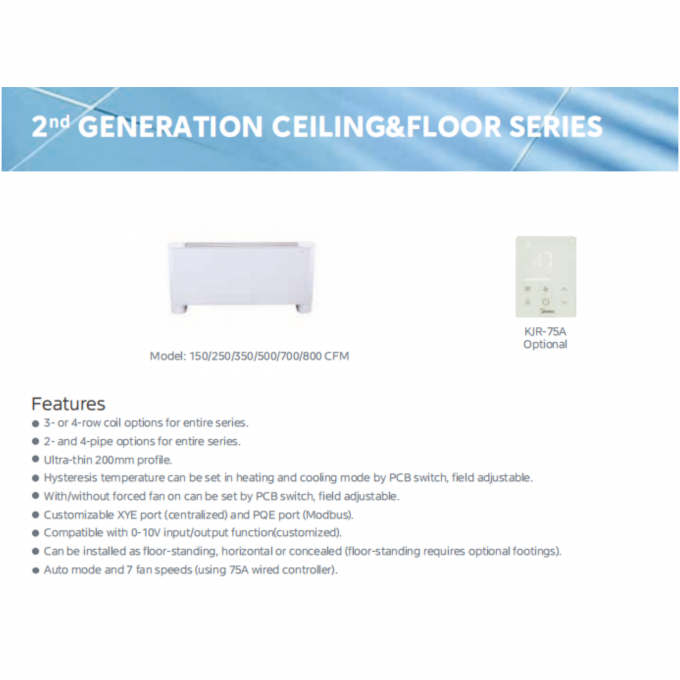
Fit-out projects often change after the order is placed: a ceiling zone becomes a floor zone, an exposed unit becomes concealed. In sustainability terms, that change is not just a programme risk — it is waste, because equipment that no longer fits the design must be returned, replaced and eventually written off. The Midea 2nd Generation Ceiling & Floor Fan Coil Unit is the one-SKU answer: three mounting modes from a single platform — H1 (exposed floor standing with side return), H2 (exposed floor standing with bottom return) and H3 (concealed ceiling with 180° coil rotation). Order before the design freezes and decide mounting as the fit-out evolves. One family covers 400–800 CFM with cooling capacities from 1.58 to 8.25 kW across the AC and DC range.
At 200–211 mm deep, the unit sits tight to walls and ceilings with no custom boxing or casing work and no extra material fabricated on site. Floor mode solves perimeter heating and cooling along glazing, where envelope loads concentrate and ceiling space is already crowded with other services; H3 mode hides the unit completely above the ceiling and rotates the coil 180° for optimal supply and return positioning inside the void. The integrated controller recess-mounts wired controllers flush, so no aftermarket brackets or surface trunking are needed. Three-row and four-row coil options match two-pipe and four-pipe hydraulics across new-build and retrofit work without site adaptation.
The DC inverter brushless version offers seven fan speeds via the KJR-75A controller plus 0–10V modulation for demand-based control, with up to 30% fan energy savings: output follows measured demand rather than cycling at a fixed setting — the difference between a comfortable energy model and a metered result. XYE and PQE ports provide central control and Modbus RTU connectivity for a clean BMS handover at commissioning. Standard supply is 220–240V / 1Ph / 50Hz, and Hongtai supports multi-site rollouts and export contracts with OEM/ODM custom voltage (180–440V, 50/60Hz), project branding and protocol options. ERP and RoHS compliance is standard.
Where the requirement is simple comfort at the sharpest price, AC 3-speed models keep the schedule of rates low. Where the client reports energy intensity by zone, wants demand-based control, or needs an efficiency line in a green building submission, specify the DC inverter brushless version: seven speeds via the KJR-75A, 0–10V modulation for BMS-driven strategies, and up to 30% fan energy savings. Mounting modes, dimensions and coil options are identical across both, so the motor decision never affects how the unit fits the room, and a project can start on AC and move to DC in later phases without redesign.
The DC version provides 0–10V modulation plus seven fan speeds, so output follows real demand under BMS strategies rather than running at a fixed setting. Combined with the brushless motor, this gives up to 30% fan energy savings against the AC equivalent.
It is designed to. H1, H2 and H3 all come from one platform, so the order can be placed before the fit-out freezes and the mounting decided later. Equipment that would have been returned and written off after a design change is simply not ordered in the wrong version.
Yes. XYE and PQE ports provide central control and Modbus RTU connectivity, so the zone data needed for reporting is available at commissioning rather than added later.
Yes, on both AC and DC series, so a mixed schedule can be submitted with one certification file covering the whole installation.
Perimeter zones along glazing are where envelope heating and cooling loads concentrate. Floor placement handles that load at the point it occurs without touching the ceiling, and H3 concealed mode rotates the coil 180° to optimise supply and return inside the void.
| Parameter | AC Series | DC Series |
|---|---|---|
| Airflow Range | 400–800 CFM | 400–800 CFM |
| Cooling Capacity | 1.58–8.25 kW | 1.65–8.25 kW |
| Heating Capacity | 1.77–8.50 kW | 1.85–8.50 kW |
| Power Input | 14–124 W | 14–123 W |
| Sound Pressure Level (H) | 34–53 dB(A) | 23–51 dB(A) |
| Power Supply | 220–240V / 1Ph / 50Hz | 220–240V / 1Ph / 50Hz |
| Body Thickness | 200–211 mm | 200–211 mm |
| Coil Rows | 3 / 4 | 3 / 4 |
| Max. Working Pressure | 1.6 MPa | 1.6 MPa |
| Motor Type | AC fan motor | DC Brushless |
| Pipe Connection | G3/4" | G3/4" |
| Mounting Options | H1 / H2 / H3 | H1 / H2 / H3 |
| Pipe System | 2-pipe / 4-pipe | 2-pipe / 4-pipe |
| External Static Pressure | 0 / 12 Pa (H3) | 0 / 12 Pa (H3) |
0-10V modulating fan coil unit · demand based ceiling floor FCU · low carbon fan coil platform · energy efficient perimeter FCU · ERP compliant ceiling floor FCU · dual mount fan coil energy saving · green building FCU retrofit · Modbus ceiling floor fan coil